

Glen Report 8.11: New Universal and Degenerate Bases
INTRODUCTION
Universal bases must exhibit the ability to replace any of the four normal bases without significantly affecting either melting behavior of duplexes or the normal activities of the modified oligonucleotide. The effect of universal bases contained in oligonucleotide primers used for sequencing or PCR must be minimal. Modified sequencing primers must generate normal sequencing ladders and PCR primers must lead to the correct amplified product. In circumstances where this can not be achieved, we must turn to degenerate bases for help. Degenerate bases code as two or more but not all of the normal bases. Primer multiplicity is eliminated using universal bases and reduced using degenerate bases.
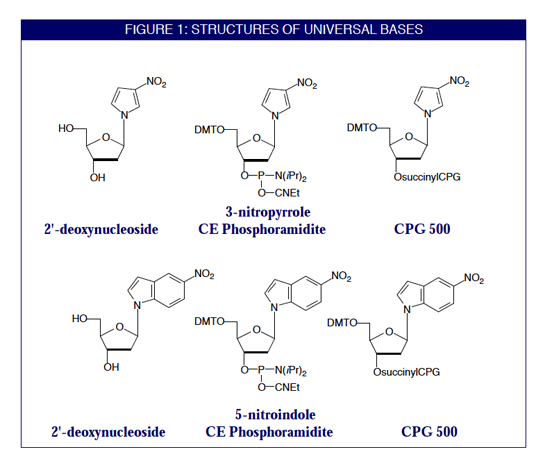
Universal Bases 3-Nitropyrrole and 5-Nitroindole
In late 1994, Glen Research began offering, under license from the University of Michigan, 3-nitropyrrole-CE phosphoramidite which was designed by researchers at Purdue University and the University of Michigan as a universal base.1,2 The strategy behind the development of 3-nitropyrrole is elegantly simple. Duplexes containing 3-nitropyrrole are stabilized by stacking interactions rather than by hydrogen bonding, thereby removing any bias for an individual complementary base. Nevertheless, duplexes containing 3-nitropyrrole at one or more positions are significantly destabilized relative to the fully complementary duplex. A subsequent report3 described the preparation of nitroindole-CE phosphoramidites and their use as universal bases. The researchers compared 4-, 5- and 6-nitroindole with 3-nitro-pyrrole as universal bases. Like 3-nitropyrrole, all three nitroindole isomers acted indiscriminately towards the four natural bases. Furthermore, based on duplex melting experiments, 5-nitro-indole was determined to be the most effective of the nitroindole isomers and to be superior to 3-nitropyrrole. The order of duplex stability was found to be 5-nitroindole > 4-nitroindole > 6-nitroindole > 3-nitropyrrole.
Degenerate Bases P and K
Some primer/template systems may be unable to tolerate the level of destabilization caused by these universal bases. Such systems may then be candidates for the use of primers containing P and K degenerate bases, where P equiv. C/T mix and K equiv. A/G mix.
UNIVERSAL BASES
Melting Behavior
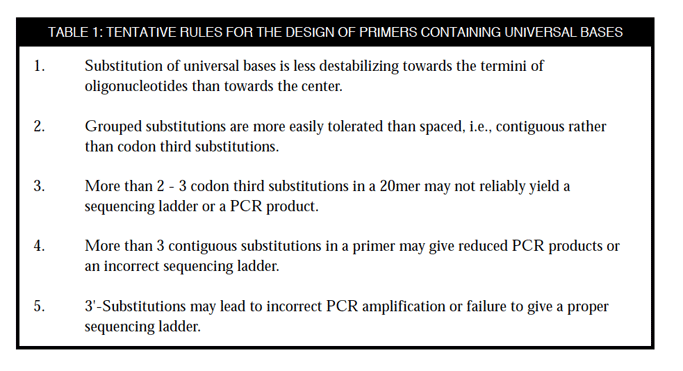
The effect of substituting sites in primers with universal bases can be simply assessed using thermal dissociation experiments. It was found1,3 that substitution with 3-nitropyrrole and 5-nitroindole towards the termini of oligonucleotides was less destabilizing than substitution towards the center. This may confirm that the universal bases stabilize the duplex by acting as intercalators. Also, oligonucleotides were destabilized less if the universal bases were grouped together rather than dispersed through the oligonucleotide. With multiple insertions, 5-nitroindole was shown to be the least destabilizing of the universal bases. Indeed, six insertions of 5-nitroindole into an oligonucleotide was found3 to be more stable than three insertions of 3-nitropyrrole based on stacking enthalpy measurements. Thermal stability studies are clearly important in validating the usefulness of any base as a universal base. However, its performance in the real world of oligonucleotides for use in sequencing and PCR primers is also critical.
Universal Bases in Primers - 3-Nitropyrrole in Sequencing and PCR
The behavior of 3-nitropyrrole in experiments using a specific primer/target system was initially reported.1 In dideoxy sequencing experiments, oligonucleotides containing 3-nitropyrrole substitutions were compared to the complementary sequence and to sequences prepared with A,C,G,T mix (N) and 2'-deoxyInosine (dI) which are the most common substitution strategies. The sequence containing 3-nitropyrrole at the third position of four codons gave an unambiguous sequencing ladder. In contrast, the sequencing ladder obtained from the identical sequence containing dI was only partially readable, while that obtained using N (a 256 fold degenerate mixture of primers) was unreadable. Acceptable sequencing ladders were also obtained when one, two and even three codons adjacent to the 3'-terminus were completely replaced by 3-nitropyrrole. It is assumed that the 2 correct bases left at the 3'-terminus in these experiments were insufficient to maintain a normal duplex at 37° and so the 3-nitropyrrole bases must contribute to correct duplex formation. Interestingly, an oligonucleotide containing 3-nitropyrrole at the 3'-terminus gave a readable sequencing ladder whereas a mismatch at the 3'-terminus did not. This result indicates that 3-nitropyrrole is an effective substrate for the polymerase enzyme rather than simply blocking chain extension. The performance of PCR primers containing 3-nitropyrrole was studied briefly and the results showed promise for this universal base.
Initial results in sequencing experiments indicate that 3-nitropyrrole seems to be performing very well. However, PCR experiments using primers with several insertions at the third position of several codons have been problematical. Presumably, problems occur when the melting temperature of the duplex falls too low.
Universal Bases in Primers - 5-Nitroindole in Sequencing and PCR
5-Nitroindole, due to its better stabilization properties, may generate improved performance in these difficult situations.3 A further publication4 from Dan Brown's group at the Medical Research Council in Cambridge, England describes a series of experiments which lead to conclusions which are in close agreement with our customer feedback. This report describes a stringent primer/template system used to evaluate the ability of duplexes containing universal bases 3-nitropyrrole and 5-nitroindole to prime DNA synthesis in both PCR and sequencing environments. In the system described, sequencing experiments were less spectacular than previously described.1,2 Only primers containing one or two substitutions at codon third positions gave readable ladders while those containing four to six substitutions failed to prime. Primers modified with up to four contiguous substitutions of 5-nitroindole led to readable ladders but only two 3-nitropyrrole substitutions were tolerated. For the template used, three contiguous substitutions of universal bases, two bases from the 3'-terminus of the primer, did not give readable ladders. Also in contrast to the previous work with 3-nitropyrrole, a primer with 5-nitroindole at the 3'-terminus did not give rise to a sequencing ladder, indicating that variations can occur among primers and templates.
Using substituted PCR primers, it was found that up to three contiguous 3-nitropyrrole substitutions and up to four 5-nitroindole substitutions were tolerated, as long as the substitutions were not adjacent to the 3'-terminus. Further substitution might be acceptable if the annealing temperature of the PCR experiment was lowered to accommodate the lower melting temperature of the duplex. Using primers containing substitutions at codon third positions, only two substitutions were tolerated for normal amplification. When four or six codon third positions were substituted by 5-nitroindole, a PCR product could be observed but in low yield. In this same system, a sequence containing six dI substitutions was an effective PCR primer.
Universal Conclusions
Some aspects of the use of universal bases in sequencing and PCR experiments have been clarified. The original report covering 3-nitropyrrole generated dramatic results which served to indicate the promise of this approach. The subsequent report about 5-nitroindole which offered at least equivalent results with less duplex destabilization, served to accentuate this interest. However, it was clear from our customers' feedback that promise does not translate into successful experiments in a wide variety of primers and templates. We have attempted to formulate some simple rules for the use of these universal bases, as shown in Table 1. With added customer feedback, perhaps these can be refined into more general rules. It is clear that there is no "universal" universal base as yet. Differing circumstances currently might dictate the use of either 3-nitropyrrole or 5-nitroindole or dI as the universal base. Clearly, the use of N at degenerate sites can play a significant role, especially in situations where the degree of degeneracy is kept low. The degenerate bases P and K, described in the next section, will clearly help since their use, even in combination, will significantly decrease primer multiplicity.
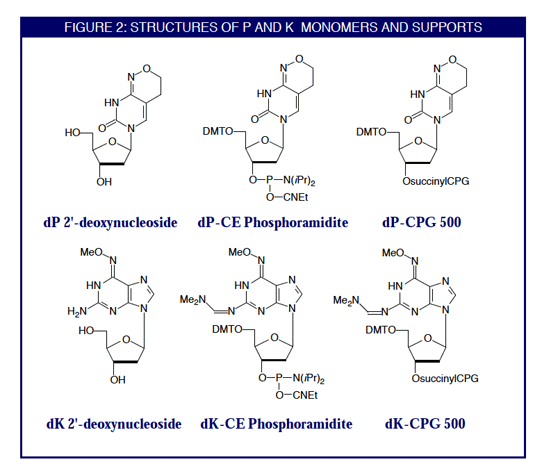
DEGENERATE BASES
The results described in the preceeding sections indicate that the search for the perfect universal base is not over. dI has functioned relatively well in its role as a universal base but its hybridization properties are not ideal and, when incorporated into PCR primers, it has been reported to code primarily as G.5 3-Nitropyrrole and 5-nitroindole are certainly significant additions to the group of universal bases but their destabilizing effect on duplexes makes them suitable for use in PCR primers with only a few substitution sites. Fully degenerate sites may be formed in an oligonucleotide using an A/C/G/T mix but the complexity of the mixture of oligonucleotides formed in this way obviously rises with each insertion and limits the usefulness of this technique. The modified bases shown in Figure 2, designated P and K, show considerable promise as degenerate bases. The pyrimidine derivative P, when introduced into oligonucleotides, base pairs with either A or G6, while the purine derivative K base pairs with either C or T.7 This is made possible by the ability of P and K to form both amino and imino tautomers, as shown in Figure 3. Oligonucleotides containing one or more P substitutions were found5 to form duplexes of stability equivalent to the parent sequence and exhibited sharp transitions on melting. Substitution with one or more K residues led to duplexes of reduced but still effective stability. Glen Research is now offering the CE phosphoramidite of P which is equivalent to a C/T mix and of K which is equivalent to an A/G mix. The structures of the CE phosphoramidites are shown in Figure 2. A P/K mix to be equivalent to an N (A/C/G/T mix) is also offered, as are the corresponding supports.
 |
 |
References:
- R. Nichols, P.C. Andrews, P. Zhang, and D.E. Bergstrom, Nature, 1994, 369, 492-493.
- D.E. Bergstrom, P. Zhang, P.H. Toma, P.C. Andrews, and R. Nichols, J. Am. Chem. Soc., 1995, 117, 1201-1209.
- D. Loakes and D.M. Brown, Nucleic Acids Res., 1994, 22, 4039-4043.
- D. Loakes, D.M. Brown, S. Linde, and F. Hill, Nucleic Acids Res., 1995, In press.
- P. Kong Thoo Lin and D.M. Brown, Nucleic Acids Res., 1992, 20, 5149-5152.
- P. Kong Thoo Lin and D.M. Brown, Nucleic Acids Res., 1989, 17, 10383.
- D.M. Brown and P. Kong Thoo Lin, Carbohydrate Research, 1991, 216, 129-139.
Product Information
3-Nitropyrrole-CE Phosphoramidite: has been discontinued,
5-Nitroindole-CE Phosphoramidite (10-1044)
dP-CE Phosphoramidite (10-1047)
dK-CE Phosphoramidite (10-1048)
dP+dK-CE Phosphoramidite (10-1049)
The synthesis supports in this article have been discontinued.
