

Glen Report 6.22: UltraFast DNA Synthesis - 10 Minute Deprotection
Commercial DNA synthesizers currently are capable of operating with fast cycles of 2 to 3 minutes. The synthesis of primers can, therefore, routinely be achieved in under 1 hour. However, a major bottleneck in processing the products is the cleavage and deprotection steps which can take anywhere from 1 to 7 hours. All this is before the isolation and/or purification strategies which take a minimum of 1 hour. It is clear that the DNA production process would benefit tremendously if cleavage and deprotection steps were streamlined.
Normal Protecting Groups
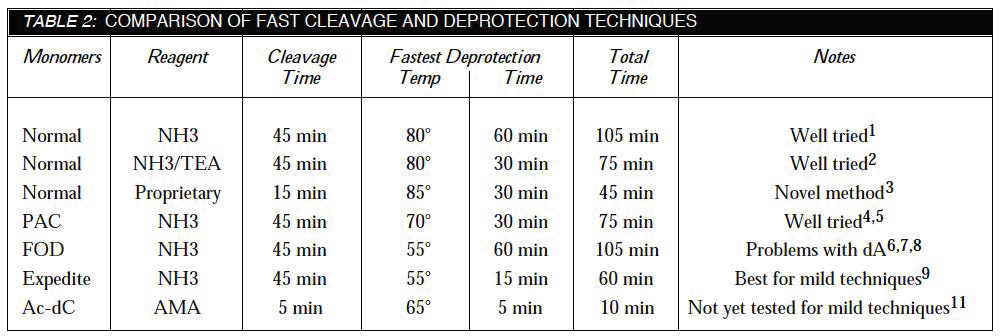
Alternative strategies have been proposed. Using the standard base protection scheme (benzoyl for dA and dC, isobutyryl for dG), deprotection can be speeded up by elevating temperature1 or combining elevated temperature (80°) with the addition of triethylamine to the ammonium hydroxide2. In addition to the potential hazard of such a high temperature, in both cases the time for both cleavage and deprotection is still at least 1 hour. A proprietary procedure developed and recently introduced by Barrskogen, Inc.3 allows cleavage and deprotection to occur in less than an hour but includes a potentially cumbersome precipitation step.
Base-Labile Protecting Groups
Using base-labile protecting groups, it is possible to reduce the deprotection time to as little as 15 minutes. However, each system introduced to date has exhibited flaws. Phenoxyacetyl (PAC) protection4 is a reasonable alternative to the standard base protecting groups but a deprotection time of 30-60 minutes5 does not include the cleavage step (normally at least 45 minutes). The PAC-dG monomer is rather insoluble and the protecting group needs to be changed to produce better solubility. It is fair to note that PAC protection is certainly an excellent mild deprotection scheme. The use of dimethylformamidine (dmf) protected monomers6 (also referred to as FOD7,8) again allows fast deprotection (1 hour at 55¡) but the cleavage time is still at least 45 minutes. There are still questions about the stability of dmf-dA during synthesis and this group may need refinement. t-Butylphenoxyacetyl protected monomers9 (known as Expediteª monomers by Millipore) also offer very fast deprotection (15 minutes at 55¡) but cleavage from the support is still 45 minutes. Expedite monomers require a different capping reagent (t-butylphenoxyacetic anhydride rather than the normal acetic anhydride) and it will be interesting to see how this affects subtle points of base modification10 and loss of capping during synthesis. Only time and extensive use will reveal any undesirable side reactions. Nevertheless, Expedite monomers are our currently preferred choice in situations where very mild deprotection of oligonucleotides is necessary, e.g., when preparing sequences containing labile nucleobases.
UltraFAST System
Relief of the production bottleneck is now at hand with the discovery of the UltraFAST cleavage and deprotection system by Beckman Instruments11. This system, for which patents are pending, requires the normal benzoyl protection of the dC monomer to be replaced with acetyl. All other monomer protecting groups remain the same. The chemical stability of the acetyl-dC monomer is equivalent to the normal benzoyl-dC monomer allowing it to be conveniently stored at controlled room temperature rather than 4¡ or below. This seemingly minor change in protecting group leads to an oligonucleotide which can be cleaved and deprotected in 10 minutes using an inexpensive reagent known as AMA. The AMA reagent is a 50:50 mixture of aqueous Ammonium hydroxide and aqueous MethylAmine. With AMA the cleavage of the oligonucleotide from the support is accomplished in 5 minutes at room temperature. The deprotection step is carried out at 65¡ for a further 5 minutes. Deprotection can also be carried out at lower temperatures as shown in Table 1. In all cases, no base modification has been observed.
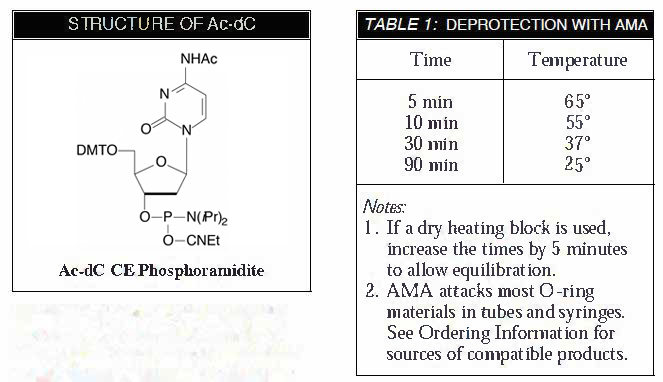
In a comparative testing of the use of acetyl-dC with normal benzoyl-dC, no differences have been observed in the final oligonucleotides by analytical techniques of HPLC, capillary electrophoresis, base composition analysis, but even more importantly in the usage of the oligonucleotides as primers in PCR and sequencing. Indeed, hundreds of oligonucleotides produced from acetyl-dC monomers have been used successfully without a single adverse observation. After deprotection, there is no need to change the procedures of Poly-Pakª purification so oligonucleotides can also be purified in a further 10 minutes with only 0.5mL of aqueous acetonitrile to evaporate prior to use. The use of Ac-dC is also compatible with ammonium hydroxide deprotection under normal conditions making this system the most ubiquitous so far offered.
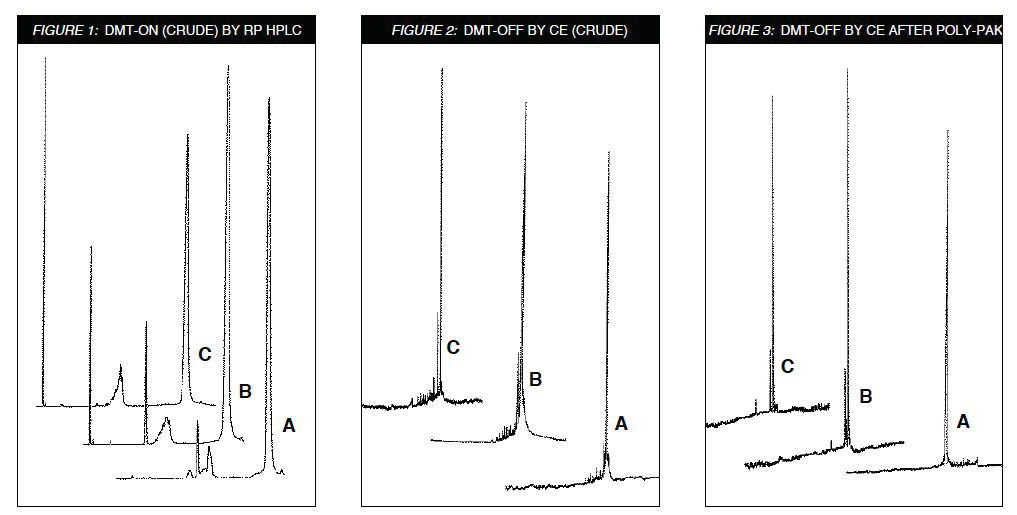
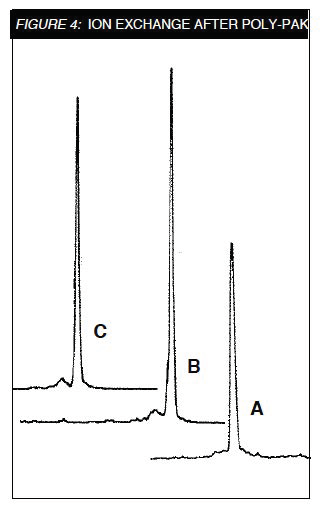
An informal comparison of the purity of an oligonucleotide produced using acetyl-dC, benzoyl-dC, and Expedite monomers was carried out. In all cases, excellent products were obtained. Figures 1 and 2 demonstrate the high quality of the crude products while Figures 3 and 4 demonstrate that the products were upgraded to very high purity using Poly-Pak cartridges.
References
(1) T.R. Reynolds and G.A. Buck, Biotechniques, 1992, 12, 518.
(2) Technical Bulletin No. 041R, Cruachem Inc., (1991).
(3) DNA Mate Reagents, Barrskogen, Inc., (1993).
(4) J.C. Schulhof, D. Molko, and R. Teoule, Nucleic Acids Res., 1987, 15, 397.
(5) Analects Vol.21, Pharmacia P-L Biochemicals, Inc., (1993).
(6) L.J. McBride, R. Kierzek, S.L. Beaucage, and M.H. Caruthers, J. Amer. Chem. Soc., 1986, 108, 2040.
(7) H. Vu, C. McCollum, K. Jacobson, P. Theisen, R. Vinayak, E. Spiess, and A. Andrus, Tetrahedron Lett., 1990, 31, 7269-7272.
(8) User Bulletin No. 57, Applied Biosystems, Inc.. (1990).
(9) N.D. Sinha, P. Davis, N. Usman, J. Perez, R. Hodge, J. Kremsky, and R. Casale, Biochimie, 1993, 75, 13-23.
(10) R.T. Pon, N. Usman, N.J. Damha, and K.K. Ogilvie, Nucleic Acids Res., 1986, 14, 6453-6470.
(11) a. G. Sasaki, J.J. Dih, and M.P. Reddy, Technical Information Bulletin T-1792, Beckman Instruments, Inc., (1993).
b. M.P Reddy and N. Hanna (patents pending).
c. M.P. Reddy, N. Hanna, and F. Farooqui (1993; manuscript in preparation).
Notes:
1. Oligonucleotide shown is a 21mer. In Figures, oligo A used Ac-dC, B normal, and C Expedite monomers.
2. Figure 1 illustrates that the different protecting groups yield different amide by-products on deprotection as well as the desired products.
3. Figure 2 confirms the excellent quality of the unpurified oligos using capillary electrophoresis.
4. Figures 3 and 4 demonstrate the high purity of these oligos after DMT-on purification by Poly-Pak.
5. These chromatograms are not intended to be a formal comparison of the methods.
6. Chromatographic conditions are available on request.
