

In this issue of The Glen Report, we are introducing a selection of new products and methodologies. One would think that capping in oligonucleotide synthesis would have been developed to the nth degree, but incomplete capping continues to be one of the main contributors to problems. We have, therefore, reviewed the capping efficiency of the current capping mixes and have compared this efficiency achieved to that achieved by a new phosphoramidite capping reagent, UniCap Phosphoramidite.
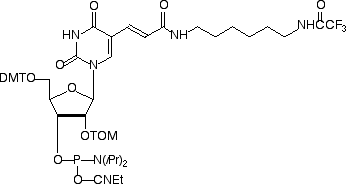
As usual, we are adding many new products to our range of nucleosides available for DNA and RNA research. As siRNA increases in significance, we have increased our focus on RNA research. We are introducing a uridine derivative (Amino-Modifier C6-U Phosphoramidite) for labeling RNA and 6-Thio-G Phosphoramidite for cross-linking to associated RNA or protein molecules. These new phosphoramidites are listed beginning on this page. We have had a long-term interest in 2'-fluoro-RNA monomers and we are happy to be able to add 2'-fluoro-A and 2'-fluoro-G to that family of products. We are also introducing our more popular supports for 3’ modification on polystyrene in columns compatible with the Applied Biosystems 3900 synthesizer.
Also, we recently completed an agreement with Biosearch Technologies to begin supplying Black Hole Quencher™ (BHQ) products to the research market. These quenchers complement our current quenchers, Dabcyl and Eclipse™, and cover the complete spectral range offered by our extensive line of fluorescent dyes.
Although molecular biology products are unusual for Glen Research, we have been working recently on preparing unusual triphosphates with specific unique properties. In partnership with Lawler Scientific, LLC, we have used our chemical expertise to produce Internally Quenched Nucleotides (IQNs), which we expect will find broad acceptance in a variety of biological applications.
We are happy to announce that our recent agreement with Isis Pharmaceuticals, Inc. allows us to begin supplying again the propynyl pyrimidine nucleoside phosphoramidites, pdC and pdU. Although these products were developed with therapeutics in mind, they found uses in antisense experiments, and in the preparation of probes with enhanced binding characteristics.
